Innovative microsimulation provides policymakers with a clear picture of how independent, nonprofit higher education institutions fill critical labor shortages, especially in nursing
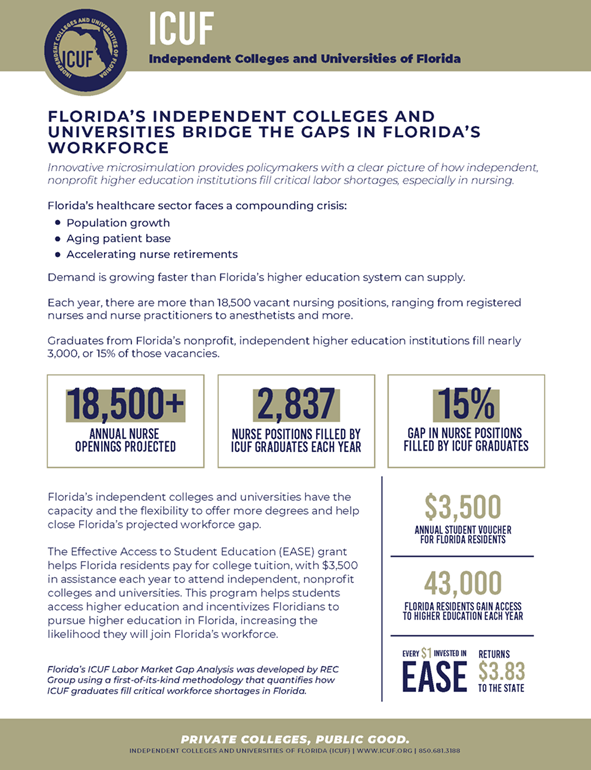
The Independent Colleges and Universities of Florida (ICUF) released a groundbreaking labor gap analysis that reveals the critical role Florida’s independent, nonprofit higher education institutions play in preparing our future workforce. Nearly 3,000 essential health care positions, according to the report, ranging from registered nurses and nurse practitioners to anesthetists and more, are filled in Florida each year by graduates of ICUF schools.
“Florida’s workforce challenges demand better data to inform better decision making,” said Bob Boyd, president and chief executive officer of ICUF. “For the first time, policymakers can see not just how many graduates Florida’s nonprofit higher education system produces, but exactly how those graduates help fill critical workforce needs across our economy. This model will serve as a guide to policymakers and key stakeholders on investments to strengthen our workforce and meet our state’s future needs.”
Florida’s healthcare sector faces a compounding crisis. Population growth, a rapidly aging patient base and accelerating nurse retirements are driving demand higher faster than Florida’s existing higher education system can supply.
“There’s no question we have to come up with creative ways to expand our workforce and provide our students with the skills they need to fill the jobs available,” said Senator Jonathan Martin (R-Fort Myers). “This labor gap analysis provides a clear picture of both the challenges and opportunities before us, enabling lawmakers to make informed decisions and strategic investments that will prepare our students and power our economy.”
According to the ICUF Labor Gap Analysis, Florida is projected to have 18,757 openings for nurse positions in 2028. That gap grows to 19,638 vacant nurse positions in 2032. More than 15% of those positions are filled with ICUF graduates each year, and these institutions have the capacity to grow their programs to help fill gaps in the workforce.
The Effective Access to Student Education (EASE) grant helps Florida residents pay for college tuition, with $3,500 in assistance each year to attend independent, nonprofit colleges and universities. This program helps students access higher education and incentivizes Floridians to pursue higher education in Florida, increasing the likelihood they will join Florida’s workforce.
More than 180,000 students choose to pursue higher education at independent, nonprofit institutions because they offer smaller classes, greater flexibility, faith-based learning or other opportunities that may not be available in traditional public school settings.
The Florida’s ICUF Labor Gap Analysis was developed in partnership with the Regional Economic Consulting (REC) Group. The team used a first-of-its-kind microsimulation model capable of tracking graduates from degree completion through job placement.
Unlike traditional workforce studies that rely on statewide occupational projections, the microsimulation accounts for individual graduates, degree fields, migration patterns and real-world labor market competition. By incorporating these factors, the model provides a more accurate representation of workforce supply and allows researchers to better capture the impacts of education and workforce planning.
The inaugural analysis modeled more than 393,000 Florida job openings alongside 35,653 ICUF graduates, finding that ICUF graduates filled nearly 34,000 positions across the state.
For more information or to view the full analysis, visit www.ICUF.org